- Your cart is empty
- Continue Shopping


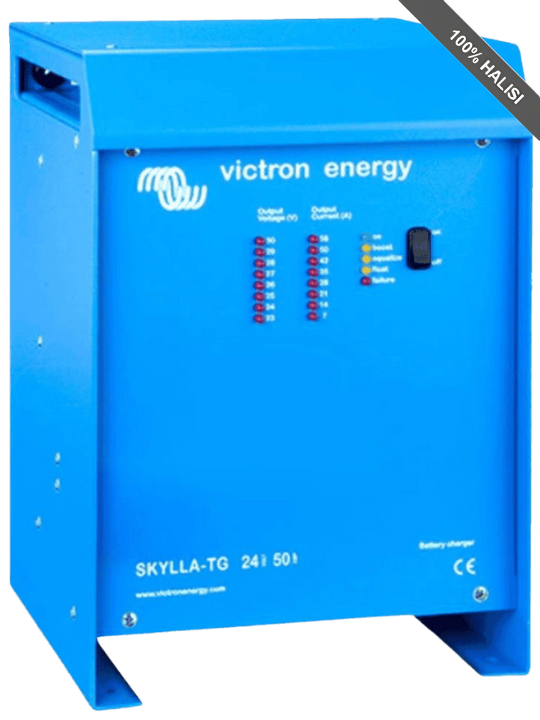
Victron Energy Skylla‑TG Charger 24/50, 24/80, 24/100, 48/25, 48/50
Victron Energy Skylla‑TG Charger 24/50, 24/80, 24/100, 48/25, 48/50
Victron Energy Skylla‑TG Charger 24/50, 24/80, 24/100, 48/25, 48/50
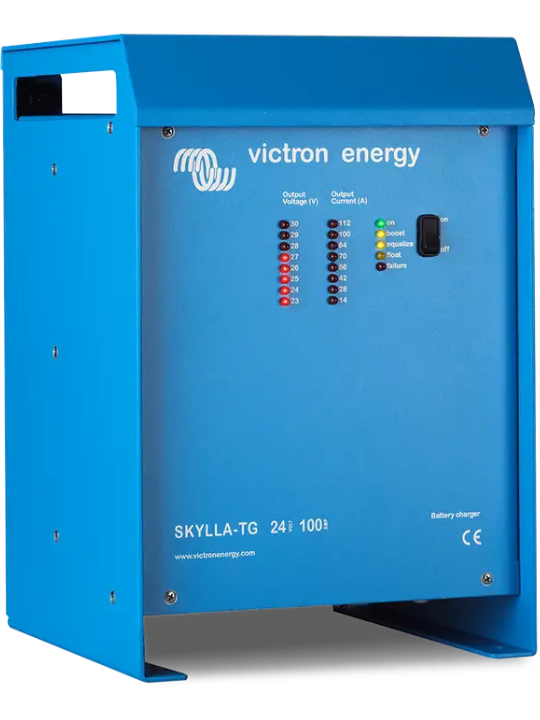
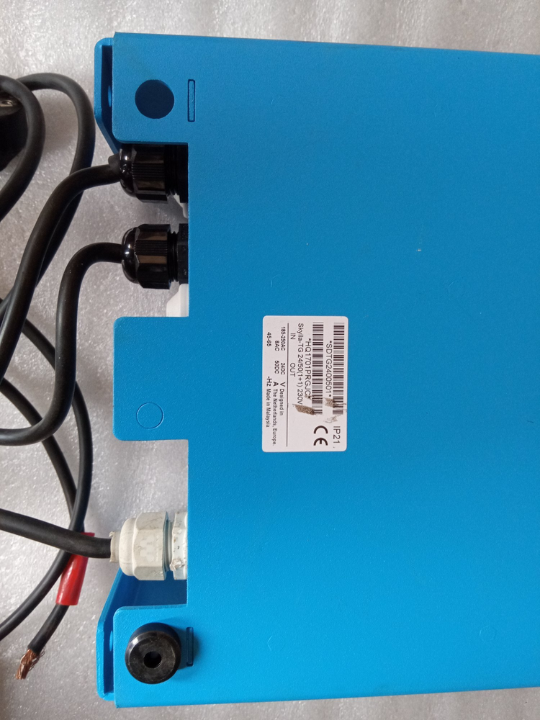
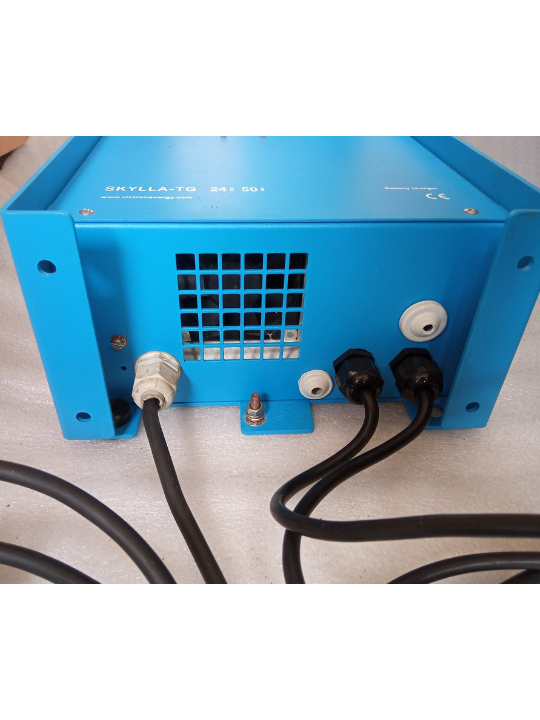
- Suitable for 24 V and 48 V systems (depending on model) with full-rated output on main bank and ~4 A auxiliary output for starter battery (24 V models).
- Microprocessor controlled charging in three stages (bulk/absorption/float) for accurate and safe battery charging.
- Battery voltage-sense facility to compensate for cable voltage drop so the battery sees correct charge voltage.
- Battery temperature sensor included; charge voltage is adjusted based on temperature to prevent over-charging especially for sealed batteries.
- Can operate as a stabilized DC power supply when no battery is connected (on suitable models).
- Robust protection short-circuit, reverse polarity (battery), over-voltage, over-temperature protections.
- Models accept wide AC input ranges (and some accept DC input) – allowing flexibility for mobile/vehicle/boat installations.
- Built for continuous connection; can stay connected to battery long-term without causing detrimental gassing / over-charging when used properly.
The Victron Energy Skylla-TG series of battery chargers is designed for demanding DC systems: marine cruising and commercial vessels, off-grid / industrial installations, and any situation where reliable high-current battery charging from AC mains (or DC input, in some cases) is required. Models in this line (24 V or 48 V, varying current ratings) combine robust build quality with advanced charging control. The unit supports a full-rated output bank plus a secondary ~4 A output (in 24 V models) for auxiliary or starter battery charging.
Input is standard 230 V AC at 50/60 Hz for most versions, making it suitable for many countries including Tanzania.
Charge voltage is precisely adjustable, and there are remote sense (battery terminal) and temperature‐sensor compensation features to ensure the battery receives the correct voltage regardless of cable drops or ambient temperature.
Key Features & Benefits
- Precise Set-Point Adjustment : The charge voltage is fully adjustable to suit sealed (e.g., AGM, Gel), flooded or traction battery types. Ensures correct charging and longevity.
- Remote Voltage Sense : Measures voltage at the battery terminals (not just at the charger output) so that cable resistance and drop are compensated for; the battery always receives optimal voltage.
- Battery Temperature Compensation : With the included temperature sensor the charger will reduce voltage when battery temperature increases, which prevents overcharging and venting (especially important for sealed batteries).
- Dual Outputs (24 V models) : One high-current output for main battery bank plus a second isolated ~4 A output for a starter or auxiliary battery. This ensures both banks are correctly charged in one unit.
- Robust Build for Harsh Environments : Metal chassis, forced airflow cooling, IP21 rating make it suitable for engine rooms, hot climates, marine salt-air environments or industrial installations — a strong benefit for Tanzania’s coastal and inland industrial use.
- Three Stage Charging Algorithm (IUoUo) : Bulk (high current) → Absorption (constant voltage) → Float (maintenance) ensures efficient and safe charging. It delivers rapid recharge and helps protect battery life.
- Regulated DC Power Supply Mode : If desired, the charger can operate as a stable DC power supply when no battery is connected (or battery is removed), offering flexibility in installations.
- Global Support and Warranty : Manufactured by Victron Energy (Netherlands) with a strong reputation in the marine, industrial and off-grid sector; global dealer network and quality warranty support bolster confidence.
Use Cases in Tanzania
- Marine vessels (yachts, fishing boats, charter boats) operating off the Tanzanian coast or on Lake Victoria, where battery banks power navigation, lighting, instrumentation and need reliable charging from mains or generator.
- Remote lodge or resort installations (on Zanzibar, Kilimanjaro base camps, safari camps) where AC mains from generator or grid is available but battery bank needs consistent high-current charging and monitoring.
- Industrial DC systems such as telecom towers, backup power banks, or mobile base station battery banks in Tanzania requiring correct charging and maintenance.
- Off-grid or hybrid solar + generator systems where the charger complements solar in feeding or topping up batteries reliably.
- Commercial vehicles or heavy‐duty installations (e.g., refrigerated trucks, service vehicles) where a robust charger is required to maintain large battery banks in hot ambient conditions typical of East Africa.
Value Proposition & Local Market Positioning
- Durability in Tropical Conditions: The forced‐air cooling, metal enclosure and remote sense/temperature features mean the unit handles high ambient temperatures, cable voltage drop and challenging environments—ideal for Tanzania’s climate.
- Battery Life & Reliability: By precisely controlling voltage and temperature compensation, the charger helps avoid over-charging, gassing and thermal stress—leading to longer battery life and less maintenance.
- Versatility: Whether for marine, industrial, or remote power use, the same charger line can cover 24 V or 48 V systems and various current levels—useful for local suppliers stocking fewer variants.
- High Current Capability: For large battery banks typical of commercial / industrial installations, choosing the 24/80 or 24/100 versions means the charger can handle larger loads with headroom.
- Local Support & Brand Reliability: Victron has global reputation; local installation partners in East Africa often favour Victron gear due to reliability and service support—important for buyers who need peace of mind.
- Future-Proofing: As Tanzanian installations grow (more solar, more battery capacity, more automation), this charger provides a solid backbone: remote monitoring, accurate control, dual bank charging (in 24 V version) and the ability to serve starter and house banks.
Local Market Considerations & Tips
- Premium segment: This is not the cheapest charger on the market—Victron commands premium pricing because of build quality, features and brand reputation. Position it as “long-term investment” for installations where reliability matters (marine charters, remote lodges, commercial systems).
- Service & warranty advantage: Highlight Victron’s global service network and warranty (the datasheet refers to a 5-year standard warranty)
- Highlight tropical suitability: Emphasize that many generic chargers are challenged by high ambient temps, cable voltage drop, poor ventilation, but this unit has remote sensing, temp compensation, forced cooling, metal chassis—making it suitable for East African conditions.
- Offer sizing guidance: Provide local installers/engineering spec support to select the right model (24 vs 48 V, current rating) so buyer is confident they are not under-sized (which would reduce battery life) nor over-spending.
- Bundle value with installation: Because it’s a professional grade product, consider offering installation services, commissioning, sensor placement, and after-sales support as part of the value proposition.
- After-sales parts & training: Emphasize availability of Victron accessories (remote panels, sensors, cables, monitoring) to tailor the installation, and possibly local training/installation support.
- Warranty & uptime assurance: For commercial users (lodges, boats) downtime is expensive—so highlight rapid response service, robust design, global brand, and how the investment pays off through minimal downtime and longer battery life.
Technical Specification
| Parameter | Typical Value / Notes |
| Input Voltage (AC) | 230 V AC, 50/60 Hz (Single-Phase) for many models. |
| Input Voltage Range (AC) | For many 24 V models: 95-264 V AC. |
| Input Voltage (DC) | Some models accept 120-400 V DC (not all). |
| Charge Algorithm | IUoUo 3-step (Bulk → Absorption → Float). |
| Charge Voltage Absorption (24 V Models) | ~ 28.5 V DC. |
| Charge Voltage Float (24 V Models) | ~ 26.5 V DC. |
| Remote Voltage Sensing | Yes — to compensate for cable resistive losses. |
| Operating Temperature | –40 °C to +50 °C (full output up to 40 °C). |
| Cooling | Forced-air cooling. |

Save More
Keep more of your money.With our efficient online operation our savings become your savings

Free Same Day Delivery
Spend over 100,000/- with us and qualify for free delivery in Dar Es Salaam. Standard delivery is just 5,000/-*

100% Warranty Goods
Unlike other online retailers we chose our suppliers carefully ensuring genuine goods backed by genuine warranties

7 Day Return
Something faulty with your product? No problem. We will arrange for an easy pick up and refund of your order within 7 days*.
Shop with complete peace of mind.
*Only available for products delivered in Dar es Salaam
Related products

EVI Power DC MCCB, 1 Pole, 160A, 1 Year Warranty
Original price was: Tsh 110,000.Tsh 97,000Current price is: Tsh 97,000.
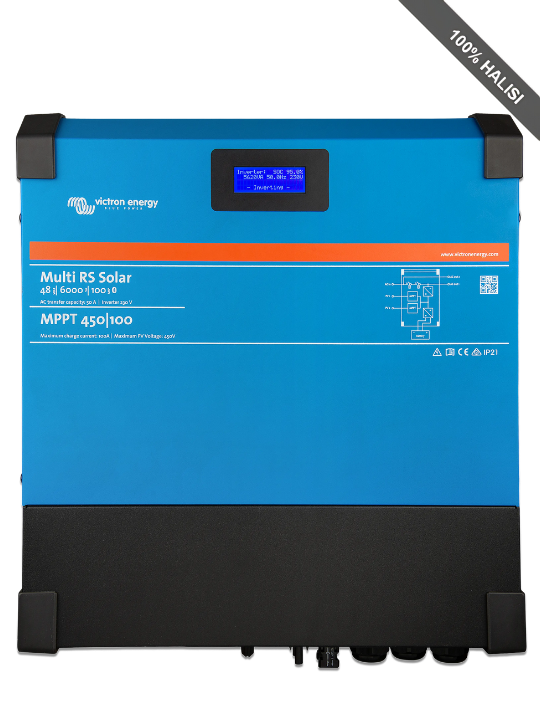
Victron Energy Multi RS Solar 6000VA Inverter/Charger 10-VIC-0408
Original price was: Tsh 6,900,000.Tsh 6,240,450Current price is: Tsh 6,240,450.

EVI Power 300W Solar Street Light with Motion Sensor & Remote Control – 410 Lumens, 7Ah Lithium Battery, Weather Resistant
Original price was: Tsh 140,000.Tsh 135,000Current price is: Tsh 135,000.

EVI Power 12V 200Ah Deep Cycle Solar Power Battery
Original price was: Tsh 1,000,000.Tsh 950,000Current price is: Tsh 950,000.

EVI Power MC4 Branch Connector 2-to-1 Male/Female Set
Original price was: Tsh 30,000.Tsh 25,000Current price is: Tsh 25,000.
EVI Power 400W High-Power Solar Street Light No Sensor- 4620lm Brightness, 35AH Battery & 46W Solar Panel
Original price was: Tsh 350,000.Tsh 330,000Current price is: Tsh 330,000.

EVI Power Black Flexible 6mm² Solar Cable Per Meter MOQ Divisible by 10
Original price was: Tsh 15,000.Tsh 12,000Current price is: Tsh 12,000.