- Your cart is empty
- Continue Shopping


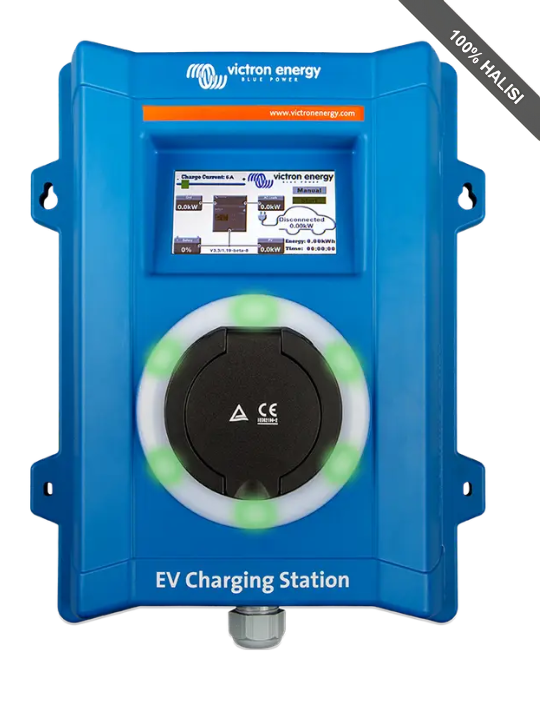
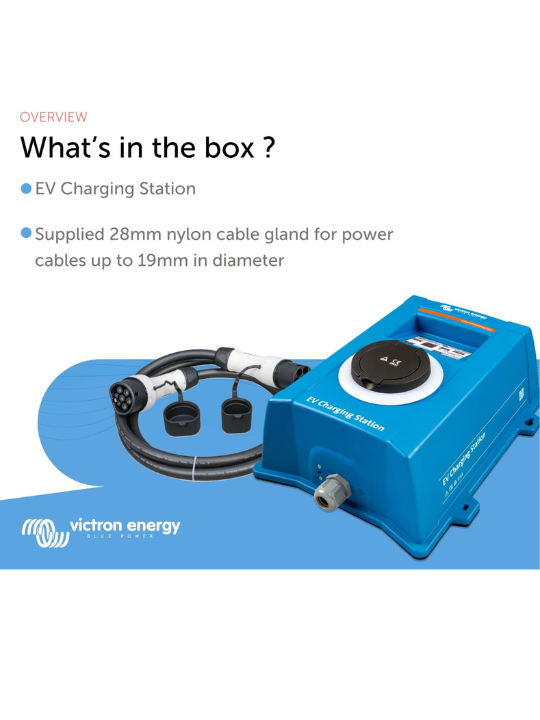
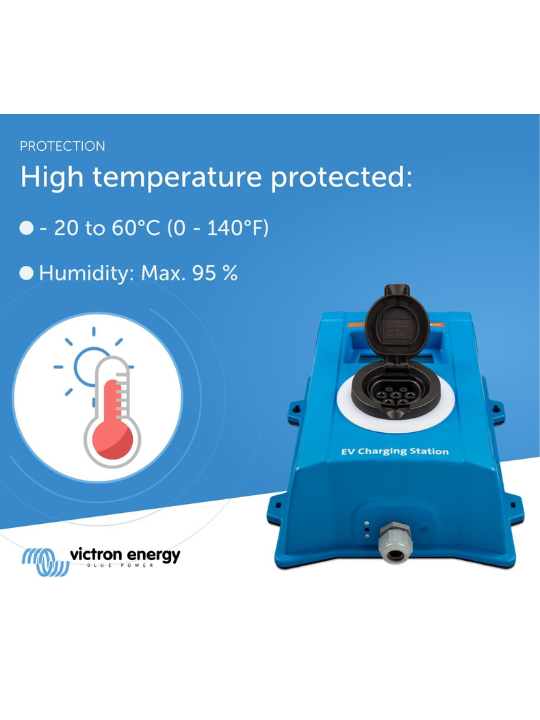
Victron Energy EV Charging Station
Victron Energy EV Charging Station
Victron Energy EV Charging Station
Tsh 2,003,400
- Supports up to 22 kW AC in three-phase mode, and 7.3 kW in single-phase mode.
- Built-in LCD touchscreen for on-device monitoring and control.
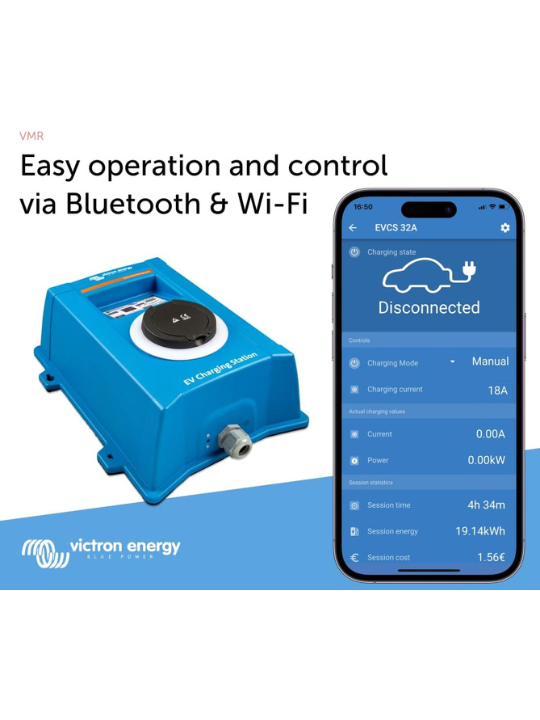
- Connectivity via Bluetooth and WiFi (access point or LAN) for setup and monitoring through VictronConnect and web interface.
- Fully integrates with the Victron Energy ecosystem—works with their GX devices and remote monitoring via VRM.
- Smart energy usage if coupled with solar panels, it can prioritise excess solar energy to charge your EV.
- Visual status indicator Programmable RGB light ring around the charging port shows different statuses (disconnected, charging, complete).
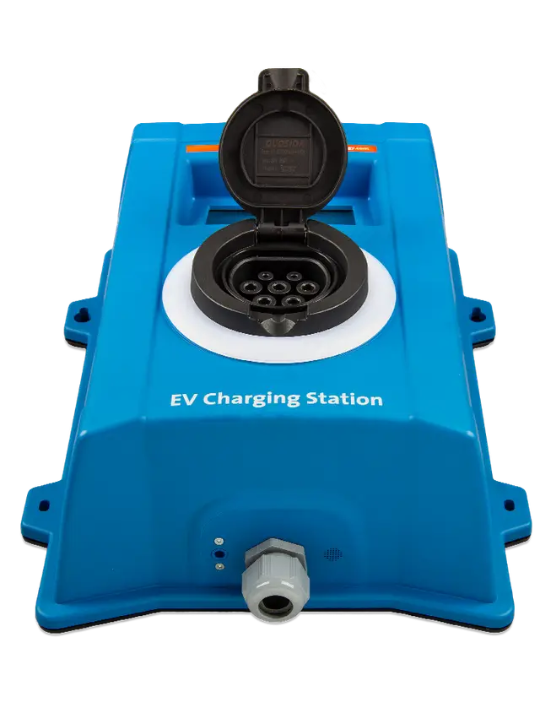
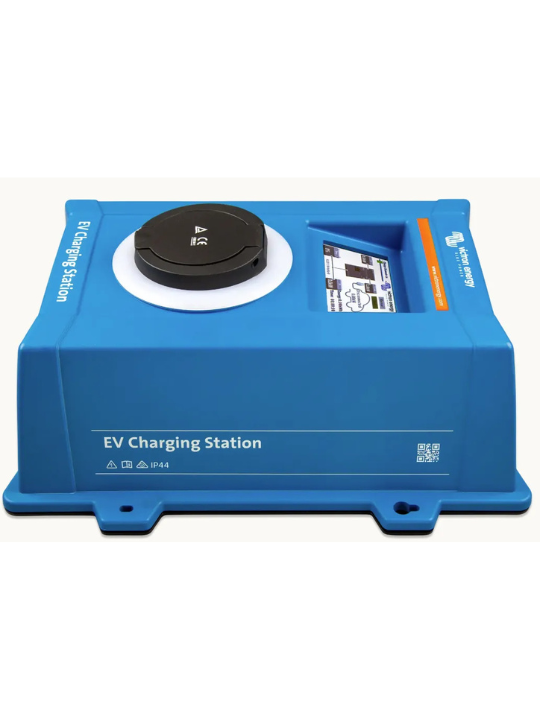
The Victron Energy EV Charging Station is a high-performance AC EV charger designed for both single-phase and three-phase installations. It supports up to 22 kW AC in three-phase mode or 7.3 kW AC in single-phase mode.
Featuring a smart touchscreen and connectivity (Bluetooth, WiFi, web interface), it is fully integrated into the Victron ecosystem, including compatibility with Victron GX devices and the VRM (Victron Remote Management) portal.
With built-in support for solar integration (excess PV power diversion), scheduling and manual modes, and an RGB status ring around the charging port, this unit brings advanced charging control to home, business or light commercial setups.
Features & Benefits
- Flexible supply compatibility: Works on single-phase or three-phase supply, meaning it can be used in varied installation contexts (residential, light commercial) depending on what wiring you have.
- Smart & connected control: Setup via Bluetooth or WiFi; local touchscreen for manual control; remote management possible via Victron GX devices and VRM platform.
- Solar and grid intelligent mode: If you already have a Victron solar / battery / inverter ecosystem, the charger can be set to use excess solar power to charge your EV (in ‘Automatic’ mode) thus making your EV charging more sustainable and cost-efficient.
- Scheduling & current limiting: You can define scheduled charging windows (for example overnight when electricity tariffs may be lower) and manually set the charging current between 6 A and 32 A to match your site’s load or supply constraints.
- Easy status monitoring: Via the built-in light-ring you and your users can quickly glance and see the charging status (green = charging, blue = ready, etc). The touchscreen and app/web interface also provide detailed session stats.
- Professional-grade build: IP44 rated, built by a trusted brand (Victron Energy), compatible with their broader energy ecosystem (inverters, battery chargers, GX control units) — helpful for integrators installing complete energy systems.
- Future-proofing & integration: With Modbus TCP, WiFi connectivity and Victron system compatibility, it offers flexibility for future upgrades, remote monitoring, fleet installations, or combining EV charging with energy storage & solar systems.
Use Cases
- Residential EV charging: For homeowners who own or are purchasing an EV (or will in the near future), in homes with either single-phase (common in many parts) or three-phase supply. The single-phase 7.3 kW mode is relevant for typical household wiring.
- Residential + Solar Hybrid Installations: For households with a solar PV system (common in Tanzania given high solar irradiance), the charger’s “Automatic Mode” can channel excess solar output to the EV, reducing grid consumption and cost.
- Fleet / Commercial installations: For small fleets (e.g., electric taxis, ride-share vehicles) or company vehicles where three-phase supply is available, the 22 kW output enables faster charging during off-peak hours or midday excess solar.
- Off-grid/Backup-integrated EV charging: In more advanced setups (solar + battery + Victron system), the charger could integrate into the energy-management system to prioritise EV charging when surplus energy is present, contributing to sustainable mobility.
- Night-tariff optimisation: With scheduled mode, charging can be set to off-peak hours (if applicable in local utility tariffs) to reduce cost.
Value Propositions
- Future-proof charging infrastructure: With Tanzania seeing growth in EV uptake (both private cars and commercial), investing in a charger that supports up to 22 kW and integrates with solar and management systems means readiness for current and upcoming needs.
- Solar synergy: Tanzania has high solar potential; this unit’s ability to charge using excess PV aligns with renewable energy goals and reduces dependence on grid/charged power cost.
- Scalable for different wiring scenarios: Whether a home has single-phase or three-phase supply, the charger adapts—reducing infrastructure change costs.
- Quality and global brand: Victron Energy is a well-known international brand with 5-year warranty, which adds reliability and reduces maintenance risk.
- Smart monitoring & control: For business owners or tech-savvy homeowners, remote monitoring through VRM and connectivity offers data, control and energy optimisation.
- Adaptable for tariff and energy-management strategies: The scheduled mode and price/kWh calculator (configurable) allow local adaptation to tariff structures, helping reduce operating cost.
Local Market Positioning in Tanzania
- Value-based messaging: Emphasise “fast, smart, solar-ready” charging. Highlight how the charger helps reduce dependency on grid power (especially relevant for regions with grid instability or expensive tariffs), enabling charging using your own solar.
- Pricing strategy: While EVs and charging infrastructure are still emerging in Tanzania, pricing should reflect premium capability and global brand. Consider including installation, configuration, solar integration support (since local installers may need training).
- Installer and service training: Ensure local partners are trained to install, configure, monitor via VictronConnect and VRM. This builds trust in the local market.
- Marketing collateral: Use data from the Laurent specifications (capacity, modes, solar integration). Provide local case-studies or proof points from similar markets (East Africa, Sub-Saharan Africa) if available. Include guidelines on three-phase vs single-phase supply, what to expect in Tanzania homes/venues.
- After-sales & warranty: Emphasise Victron’s 5-year warranty standard and global support network. This reassures buyers.
- Regulatory / grid compatibility: In Tanzania, confirm compatibility with local grid voltage (230 V single phase typical, some three-phase installations). Provide guidance on installation standards, protective devices (RCDs, breakers) which are required per spec. For example, external RCD is required.
- Bundle options: Combine with Victron GX device, solar inverter, battery storage, and monitoring service. For example: “Charge your EV with your own solar surplus — integrate with your Victron system.”
Technical Specification
| Specification | Details |
|---|---|
| AC Output / Modes | Three-phase: up to 22 kW AC; Single-phase: up to 7.3 kW |
| Input Voltage Range | 170 – 265 VAC, 50 Hz |
| Input Voltage (AC) | 85 – 265 VAC (full power from ~100 VAC) |
| Rated Charge Current | 32 A per phase (when at maximum) |
| Current Output Range | Configurable between 6 A and 32 A |
| Connector Type | IEC 62196 Type 2 |
| WiFi / Communication | WiFi 802.11 b/g/n (2.4 GHz) – supports AP or Station mode |
| Bluetooth / App | Setup, monitoring and control via VictronConnect via Bluetooth and/or web interface |
| Colour / Finish | Standard light-blue (RAL 5012) finish; (for “NS” variant other colours available) |
| Light Ring | Programmable RGB light ring around charging port (shows status: disconnected, charging, charged etc) |

Save More
Keep more of your money.With our efficient online operation our savings become your savings

Free Same Day Delivery
Spend over 100,000/- with us and qualify for free delivery in Dar Es Salaam. Standard delivery is just 5,000/-*

100% Warranty Goods
Unlike other online retailers we chose our suppliers carefully ensuring genuine goods backed by genuine warranties

7 Day Return
Something faulty with your product? No problem. We will arrange for an easy pick up and refund of your order within 7 days*.
Shop with complete peace of mind.
*Only available for products delivered in Dar es Salaam
Related products

EVI Power 300W Solar Street Light with Motion Sensor & Remote Control – 410 Lumens, 7Ah Lithium Battery, Weather Resistant
Original price was: Tsh 140,000.Tsh 135,000Current price is: Tsh 135,000.

EVI Power DC Fuse Holder With Fuse, 2 Pole 30A
Original price was: Tsh 50,000.Tsh 38,000Current price is: Tsh 38,000.

EVI Power 48V 105Ah LiFePO4 Rack Mounted Battery Module – 5.04kWh Energy Storage System, 6000+ Cycles at 80% DOD, 5-Year Warranty
Original price was: Tsh 4,430,000.Tsh 4,210,000Current price is: Tsh 4,210,000.

EVI Power 410W Monocrystalline Solar Panel – Half-Cell Design, High Efficiency
Original price was: Tsh 270,000.Tsh 250,000Current price is: Tsh 250,000.

EVI Power 51.2V 200Ah LiFePO4 Rack Mounted Battery Pack with LCD Display – 10.24kWh Capacity, 80% DOD 6000+ Cycles, 5-Year Warranty (EVIA200LFP-51.2R)
Original price was: Tsh 8,290,000.Tsh 7,890,000Current price is: Tsh 7,890,000.

EVI Power 51.2V 100Ah LiFePO4 Wall Mounted Battery Pack with LCD Display – 5.12kWh Capacity, 80% DOD 6000+ Cycles, 5-Year Warranty (EVIA100LFP-51.2W)
Original price was: Tsh 4,830,000.Tsh 4,600,000Current price is: Tsh 4,600,000.

EVI Power 12V 200Ah Deep Cycle Solar Power Battery
Original price was: Tsh 1,000,000.Tsh 950,000Current price is: Tsh 950,000.

EVI Power MC4 Branch Connector 2-to-1 Male/Female Set
Original price was: Tsh 30,000.Tsh 25,000Current price is: Tsh 25,000.