- Your cart is empty
- Continue Shopping


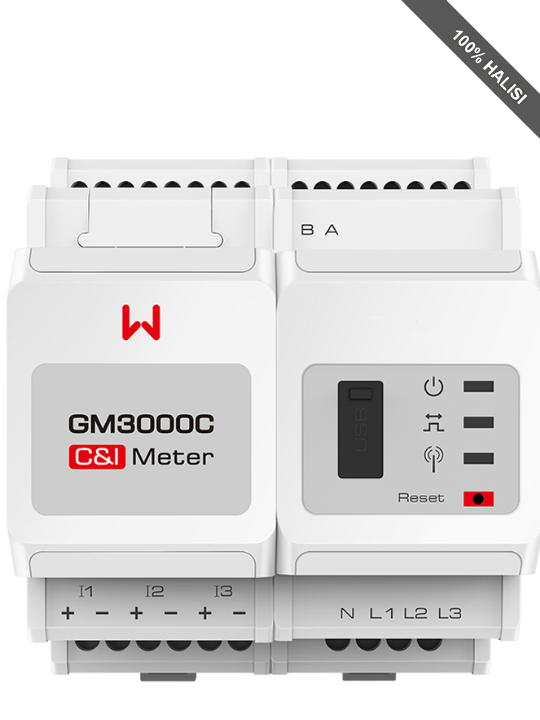
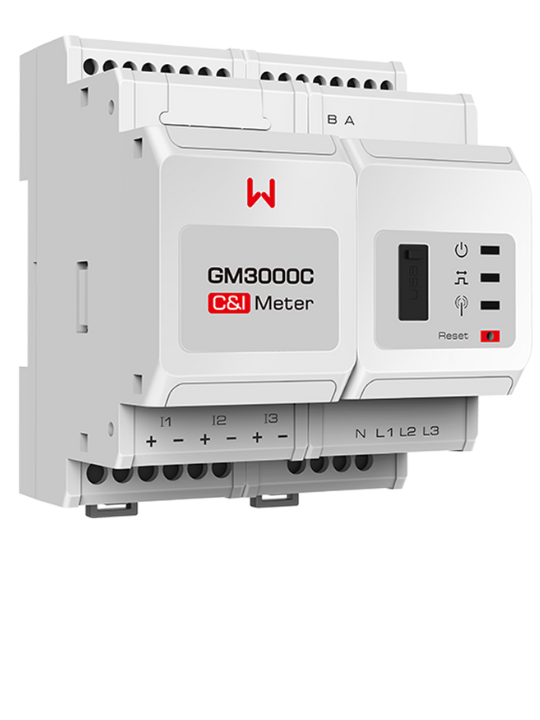
GoodWe – 3 Phase 5kA Commercial and Industrial Smart Meter – GM3000C
GoodWe – 3 Phase 5kA Commercial and Industrial Smart Meter – GM3000C
GoodWe – 3 Phase 5kA Commercial and Industrial Smart Meter – GM3000C
Tsh 548,550
- Designed for three-phase systems and large loads, ideal for commercial & industrial installations.
- Wide input voltage range (nominal 230 V line-to-neutral / 400 V line-to-line) and supports large current ranges via external CTs.
- External current transformers (CTs) can be connected with configurable CT ratio via the SolarGo app for flexible installation.
- RS485 communication interface enables connection with GoodWe three-phase inverters for export power control and system monitoring.
The GoodWe GM3000C is a three-phase smart meter designed specifically for commercial and industrial photovoltaic (PV) installations. It monitors key electrical parameters at the grid‐connection point (consumption, export, demand) and interfaces via RS-485 communication to enable export power control of GoodWe three-phase inverters. OECD systems with large loads or high self‐consumption in Tanzania-type installations (shops, factories, hotels, large offices) can benefit from the GM3000C’s wide detection ranges and flexible CT (current transformer) inputs.
Features & Benefits
- Wide voltage and current detection range: The GM3000C supports a large detectable input range (noted in marketing as 100 Vac–240 Vac / wide current via CTs) which makes it suitable for heavy‐load commercial systems.
- Flexible CT input & ratio setting: You can connect third-party CTs (Current Transformers) tailored to your load level; the CT ratio can be configured via the SolarGo app. This gives flexibility in installations in Tanzania where measured load may vary.
- Export power control: Through RS-485 interface, the meter communicates with GoodWe three-phase inverters (and other compatible systems) enabling export limitation or control – useful where grid export restrictions or tariffs apply.
- Real‐time monitoring of consumption/demand/export: The meter tracks voltage, current, active/reactive power, energy flows – enabling system owners to monitor self‐consumption, grid draw, and export.
- Low internal consumption: With consumption below 3 W, the impact on the system power draw is negligible, helpful in large installations.
- Compact design & easy DIN-rail installation: Mounts easily inside distribution boards, switchboards, making integration into commercial electrical rooms straightforward.
- Wide environmental tolerance: Operating over a wide temperature/humidity range, suitable for Tanzania’s climate (hot, possibly dusty, indoor switchrooms).
- Compatibility with SEMS portal/monitoring: Works with GoodWe’s monitoring ecosystem, allowing remote monitoring, data logging, etc.
Use Cases
- Commercial rooftop PV plus consumption monitoring: A hotel, restaurant, or office in Dar es Salaam installs a 100–500 kW PV system. The GM3000C is installed at the main supply board to monitor how much of the PV generation is consumed onsite vs exported. It also helps enforce export limits if required by utility.
- Industrial facility with large loads + PV: A factory with heavy machinery uses PV to offset daytime consumption. The GM3000C monitors bulk loads (via CTs), provides accurate measurement of demand peaks, and supports export control of excess solar.
- Mixed‐use buildings / malls: In a shopping mall with shops, utilities, and PV on the roof, the GM3000C centrally records consumption and export and can help allocate energy costs or implement load management.
- Energy service companies (ESCOs): An ESCO offering self‐consumption optimisation or power‐export management leases or installs the meter to monitor and enforce export limits, interface with inverters for active control.
- Grid‐constrained installations: Suppose the local utility (Tanzania Electric Supply Company Limited – Tanesco) limits export or applies tariffs for exported energy. Using the GM3000C to precisely measure and limit export helps comply with regulations and avoid penalties.
- Large residential‐commercial hybrid sites: In gated communities or mixed residential/commercial estates, the GM3000C monitors communal loads and PV export-import, improving billing accuracy.
Value Propositions
- Accurate measurement drives cost savings: By measuring consumption, demand, and export accurately, system owners avoid overpaying for grid draw, maximise onsite consumption of solar, and avoid export‐penalties or missed export credits.
- Scalable for large systems: With CT ratio flexibility (up to several kA), it suits installations with heavy loads (factories, hotels) rather than only small individual installs.
- Supports self-consumption maximisation: For owners wanting to use solar generation first onsite (rather than export), the meter coupled with inverter export control enables that business model.
- Compliance & monitoring: For projects that require monitoring (loan financed, ESCO contracts, incentive schemes), the GM3000C delivers data for performance tracking.
- Robust for Tanzania conditions: Indoor installation, IP20 rating, wide temperature range – suitable for utility rooms in Tanzanian commercial sites (though still indoor protected environment is recommended).
- Brand strength & ecosystem: GoodWe is a well-known PV inverter/monitoring provider. Pairing the GM3000C with GoodWe inverters gives an integrated system (monitoring portal, communication protocols), reducing compatibility risk.
- Cost-effective alternative to separate complex metering: Offering a dedicated smart meter for consumption/export means installers need fewer separate devices (PLC, metering CTs, separate controller) – simplifying design and lowering installation cost.
Local Market Positioning in Tanzania
- Import & installation logistics: For Tanzania, the meter should be procured via authorised distributors/importers, ensuring local warranty support, and that CTs and RS-485 communication cables are compatible with local switchgear and wiring practices.
- Utility interaction: For sites exporting to the Tanesco grid, or under a feed-in-tariff / net-metering scheme, ensure the GM3000C meets any local metering certification/regulatory requirements (e.g., Tanzania Bureau of Standards).
- Language/training: Provide local installers with training on configuring the CT ratio (via SolarGo app), commissioning RS-485 links to inverters, and reading data via GoodWe SEMS portal.
- Calibration & verification: Because the meter plays a key role in billing or export control, periodic verification/calibration may be required; this should be communicated to the customer.
- Tanzania climate & installation environment: While the unit is rated for indoor use (IP20), ensure the metering board is adequately ventilated and protected from dust, humidity, and heat; many sites in Tanzania may have switchrooms with elevated temperatures – ensure ambient does not exceed rated limits.
- Competitive differentiation: In marketing to Tanzanian C&I customers, emphasise that the GM3000C supports large loads (kA via CTs), offers export‐control via RS-485 (not just passive metering), and integrates nicely with GoodWe inverter ecosystem – this distinguishes it from generic energy meters.
- ROI messaging: For Tanzania’s rising industrial/commercial solar market, communicate that accurate measurement and export management help accelerate ROI: less wasted solar, lower grid bills, better utilisation of PV generation.
- After-sales support & availability: Ensure spare CTs, cables, and documentation (in English, possibly Swahili) are available locally; customers will value reliable support when investing in C&I systems.
Technical Specification
| Parameter | Specification |
|---|---|
| Application | Three-phase grid system |
| Nominal voltage (Line-to-line) | 400 Vac (or here specified as “Three-phase 230Vac” line-to-neutral) |
| Voltage input range | Broad – designed for 100 Vac–240 Vac (wider detection range) as per marketing text |
| Frequency | 50 Hz / 60 Hz |
| Current input via CT | Accepts third-party CTs; CT ratio configurable via SolarGo app; example ratio range 200 A≤N≤5000 A (with CT input 5 A) |
| Communication interface | RS-485 (for inverter connection/export control) |
| Accuracy class | Voltage/Current: Class 1; Active energy: Class 1; Reactive energy: Class 2 |
| Self-consumption | < 3 W |
| Protection rating | IP20 (indoor installations) |
| Operating temperature | −25 °C to +60 °C (or −20 °C to +60 °C per some sources |
| Mounting | DIN‐rail (4 module width) |
| Weight | 0.20 kg |
|---|

Save More
Keep more of your money.With our efficient online operation our savings become your savings

Free Same Day Delivery
Spend over 100,000/- with us and qualify for free delivery in Dar Es Salaam. Standard delivery is just 5,000/-*

100% Warranty Goods
Unlike other online retailers we chose our suppliers carefully ensuring genuine goods backed by genuine warranties

7 Day Return
Something faulty with your product? No problem. We will arrange for an easy pick up and refund of your order within 7 days*.
Shop with complete peace of mind.
*Only available for products delivered in Dar es Salaam
Related products

EVI Power 1000VA/900W Smart Hybrid Inverter, LCD Display, Fast 20A Charging, 2-Year Warranty
Original price was: Tsh 510,000.Tsh 480,000Current price is: Tsh 480,000.

EVI Power MC4 Branch Connector 2-to-1 Male/Female Set
Original price was: Tsh 30,000.Tsh 25,000Current price is: Tsh 25,000.

EVI Power 51.2V 200Ah LiFePO4 Rack Mounted Battery Pack with LCD Display – 10.24kWh Capacity, 80% DOD 6000+ Cycles, 5-Year Warranty (EVIA200LFP-51.2R)
Original price was: Tsh 8,290,000.Tsh 7,890,000Current price is: Tsh 7,890,000.

EVI Power 48V 105Ah LiFePO4 Rack Mounted Battery Module – 5.04kWh Energy Storage System, 6000+ Cycles at 80% DOD, 5-Year Warranty
Original price was: Tsh 4,430,000.Tsh 4,210,000Current price is: Tsh 4,210,000.
JA Solar 1500V Bifacial Solar Panel, 575W N-Type Double Glass, Silver Frame – JAM66D42-575/MB
Original price was: Tsh 270,000.Tsh 250,000Current price is: Tsh 250,000.
EVI Power 51.2V 100Ah LiFePO4 Rack Mounted Battery Pack with LCD Display – 10.24kWh Capacity, 80% DOD 7000+ Cycles, 5-Year Warranty – EVIA100LFP-51.2
Original price was: Tsh 2,900,000.Tsh 2,760,000Current price is: Tsh 2,760,000.

EVI Power DC Fuse Holder With Fuse, 2 Pole 30A
Original price was: Tsh 50,000.Tsh 38,000Current price is: Tsh 38,000.