- Your cart is empty
- Continue Shopping


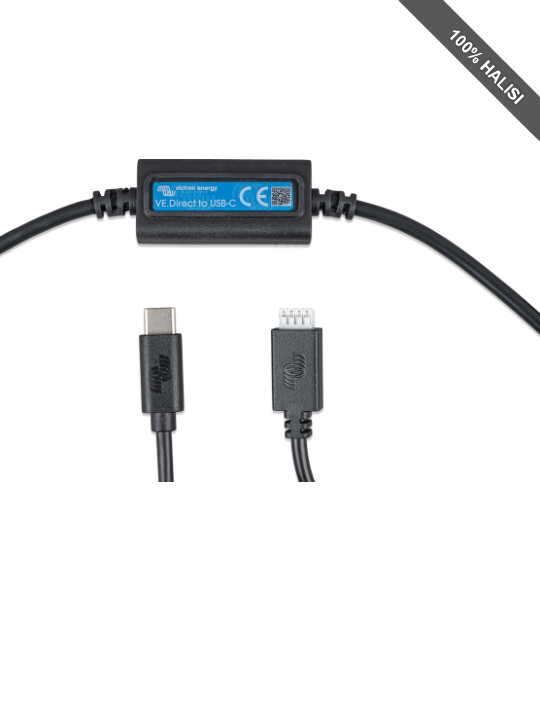
Victron Energy VE.Direct to USB Interface
Victron Energy VE.Direct to USB Interface
Victron Energy VE.Direct to USB Interface
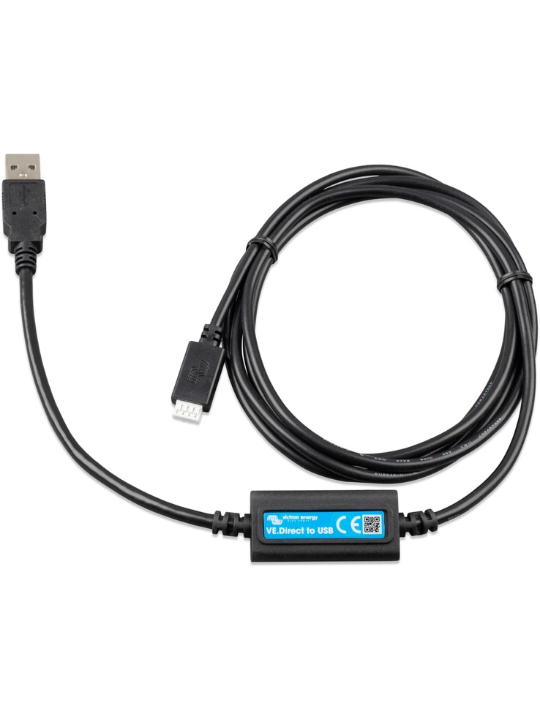
Tsh 98,050
- Connect VE.Direct devices (battery monitors, MPPT controllers) to USB-enabled devices
- Enables system monitoring, configuration, and data logging
- Allows connecting multiple VE.Direct products to a single GX device
- Compatible with CCGX, Cerbo GX, and other VE.Direct-capable devices
- Plug-and-play design for quick installation
- Durable and supported by Victron’s global warranty
The VE.Direct to USB Interface is a practical, modest-cost but highly useful accessory for anyone deploying small to medium scale off-grid solar, battery, or inverter systems — especially in regions like Tanzania where flexible, scalable, and maintainable installations are common. Its ability to bridge proprietary Victron devices (VE.Direct) with standard USB-equipped computers/controllers makes it a valuable tool for monitoring, configuration, expansion, and maintenance.
Features & Benefits
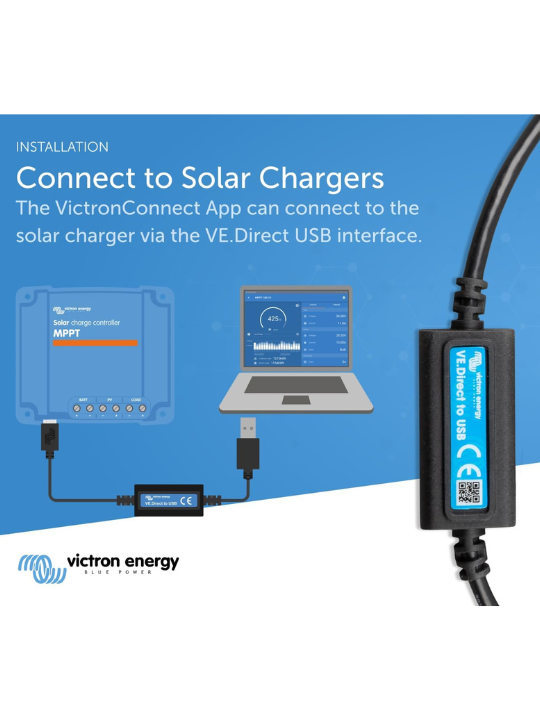
- Flexible connectivity: Turns a VE.Direct port into a USB interface, enabling connection to laptops, PCs, or USB‑enabled controllers. This is useful for configuration, firmware updates, monitoring, data export, and diagnostics.
- Expand system capacity: Allows you to connect more VE.Direct devices than the available dedicated VE.Direct ports on a monitoring/controller device (like a GX). This is particularly helpful in larger off‑grid or hybrid solar/battery installations where multiple devices (battery monitors, solar chargers, shunts, etc.) need to be networked.
- Simplicity & standardization: Since USB is ubiquitous, using a VE.Direct to USB interface simplifies wiring and offers a standard connection method rather than proprietary or custom wiring.
- Compatibility with Victron ecosystem: Because Victron uses VE.Direct widely across many of its devices (e.g. solar charge controllers, battery monitors, smart chargers), this adapter helps integrate various components into a unified monitoring or control system.
- Cost-effective solution for expansion: Compared with more complex communication interfaces (e.g. VE.Can networks), this adapter provides a straightforward and likely more affordable way to increase connectivity.
Use Cases
- Off-grid solar + battery systems: In installations combining solar panels (MPPT controllers), battery monitors (BMV or SmartShunt), and an overall system controller (e.g. GX device), this adapter helps tie all devices together for monitoring and data logging.
- System configuration and maintenance: When servicing or configuring a Victron device (e.g. updating firmware, changing settings), connecting via USB to a laptop or desktop for direct access.
- Remote monitoring setup: For systems that need data export or logging to external controllers, monitoring platforms, or home automation hardware (e.g. Raspberry Pi, Orange Pi) — as some installers do — enabling remote dashboards or energy management systems.
- Expanding small installations: For small or medium scale solar + battery setups where user wants to monitor multiple components without investing in larger CAN‑bus networks.
Value Propositions
- Scalability: Easily expand the number of VE.Direct devices in a system without complex rewiring or network redesign.
- Universal connectivity: Using USB — a standard interface — ensures compatibility with commonly available devices (PCs, controllers, hubs), lowering the barrier for setup or maintenance.
- Reliability and support: As part of Victron’s branded accessories, it benefits from warranty and global support, which matters for long-term off-grid systems.
- Cost‑effective: Compared to setting up a full CAN‑bus network (which may require additional controllers, terminators, power supply), this is a simpler and cheaper solution for many use cases.
- Flexibility for installers and end‑users: Whether you are a homeowner installing a solar + battery system, or a professional installer managing multiple components, this adapter offers versatility and ease of integration.
Local Market Positioning in Tanzania
- Rising interest in off-grid solar + battery systems: Many parts of Tanzania — especially rural or remote areas — rely on solar energy systems. A product that simplifies monitoring and integration of solar charge controllers, inverters, battery monitors, and controllers would find demand.
- Lower-cost, modular system growth: Installers and small businesses may prefer modular, scalable systems rather than large pre-built solutions. The VE.Direct to USB interface allows them to start small (one or two devices) and grow.
- Ease of maintenance and configuration: Local technicians may lack specialized equipment; a USB interface lowers the technical barrier, enabling configuration using a laptop or standard computer — something readily available.
- Compatibility with global Victron ecosystem: Because Victron is a global brand with distributed supply lines and support, buyers in Tanzania are more likely to find replacements, support, or compatible components — boosting confidence.
- Affordability relative to full CAN networks: For cost-sensitive markets, this interface offers a simpler & cheaper alternative to complex communication networks — appealing to both individuals and small businesses (shops, remote installations).
Technical Specification
| Parameter | Detail |
|---|---|
| Interface / Connectors | VE.Direct port on one end → USB (Type A) on the other end |
| Function | Converts VE.Direct protocol/data stream to USB communication, enabling computers or USB‑equipped controllers to read data from VE.Direct devices. |
| Compatibility | Works with Victron devices having a VE.Direct port — e.g. battery monitors (BMV series), MPPT solar charge controllers, Smart IP43 chargers, and other VE.Direct-capable hardware. |
| Use with GX devices | Enables connecting more than two VE.Direct devices to a single GX controller (e.g. CCGX, Cerbo GX) by converting extra VE.Direct connections into USB — because the GX has limited direct VE.Direct ports. |
| System Limits | For example, for a GX device like CCGX, the total number of VE.Direct devices (direct + via USB) that can be connected is limited (for CCGX this is up to 5 devices). |
| Cable / Length Limitations | VE.Direct cables (standard ones) have a maximum length of 10 meters and cannot be extended. If longer cable runs are required, using VE.Direct to USB + active USB extension is an alternative. |

Save More
Keep more of your money.With our efficient online operation our savings become your savings

Free Same Day Delivery
Spend over 100,000/- with us and qualify for free delivery in Dar Es Salaam. Standard delivery is just 5,000/-*

100% Warranty Goods
Unlike other online retailers we chose our suppliers carefully ensuring genuine goods backed by genuine warranties

7 Day Return
Something faulty with your product? No problem. We will arrange for an easy pick up and refund of your order within 7 days*.
Shop with complete peace of mind.
*Only available for products delivered in Dar es Salaam
Related products
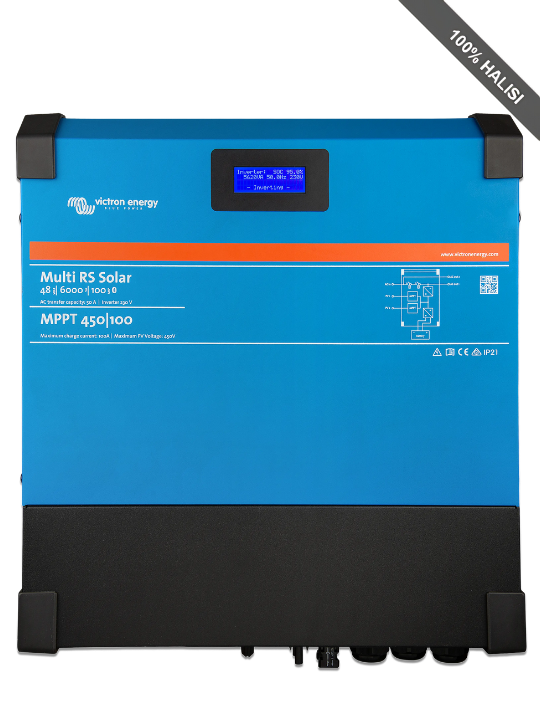
Victron Energy Multi RS Solar 6000VA Inverter/Charger 10-VIC-0408
Original price was: Tsh 6,900,000.Tsh 6,240,450Current price is: Tsh 6,240,450.

EVI Power 12.8V 100Ah LiFePO4 Battery with Smart BMS | 1.28kWh Lithium Iron Phosphate Solar Battery | IP65 Rated
Original price was: Tsh 820,000.Tsh 780,000Current price is: Tsh 780,000.
Fortuner Deep Cycle Solar Battery, 12V/7Ah AGM, VRLA Maintenance-Free – FR12-7D
Original price was: Tsh 80,000.Tsh 67,000Current price is: Tsh 67,000.

EVI Power 48V 105Ah LiFePO4 Rack Mounted Battery Module – 5.04kWh Energy Storage System, 6000+ Cycles at 80% DOD, 5-Year Warranty
Original price was: Tsh 4,430,000.Tsh 4,210,000Current price is: Tsh 4,210,000.

EVI Power 400W High-Power Solar Street Light No Sensor- 4620lm Brightness, 35AH Battery & 46W Solar Panel
Original price was: Tsh 350,000.Tsh 330,000Current price is: Tsh 330,000.
EVI Power 300W Solar Street Light with Motion Sensor & Remote Control – 410 Lumens, 7Ah Lithium Battery, Weather Resistant
Original price was: Tsh 140,000.Tsh 135,000Current price is: Tsh 135,000.

EVI Power 440W N-Type Half-Cell Monocrystalline Solar Panel
Original price was: Tsh 290,000.Tsh 270,000Current price is: Tsh 270,000.

EVI Power 12V 100Ah Deep Cycle Solar Power Battery
Original price was: Tsh 460,000.Tsh 430,000Current price is: Tsh 430,000.