- Your cart is empty
- Continue Shopping


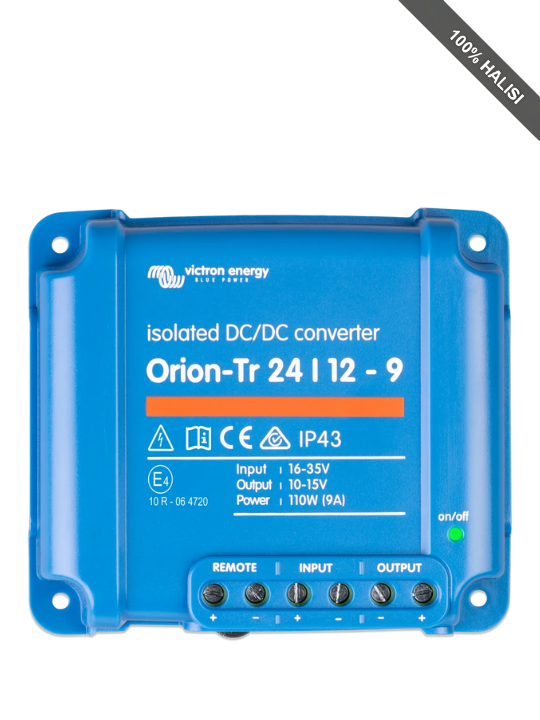
Victron Energy Orion-Tr DC-DC Converters Isolated Series
Victron Energy Orion-Tr DC-DC Converters Isolated Series
Victron Energy Orion-Tr DC-DC Converters Isolated Series
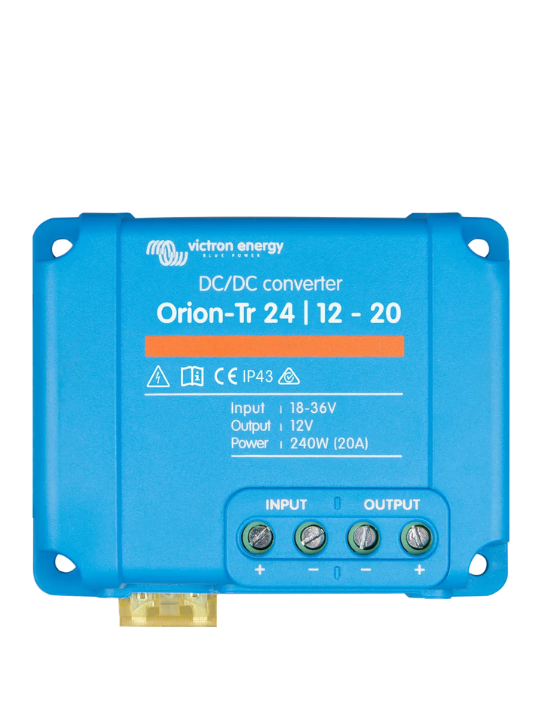
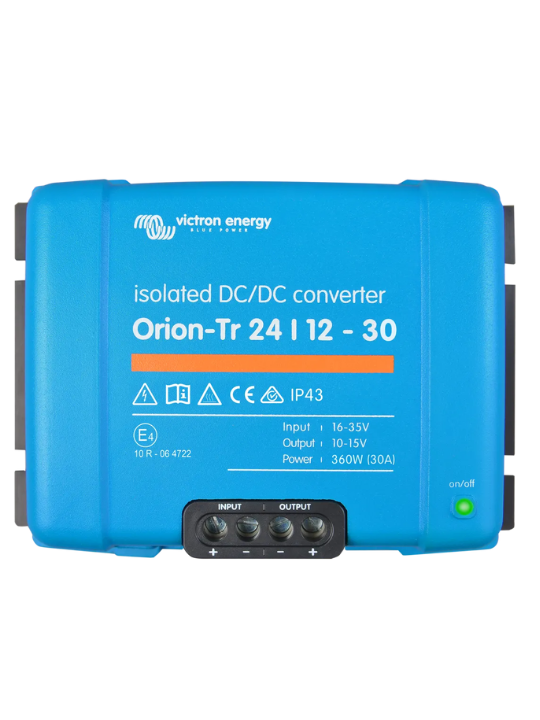
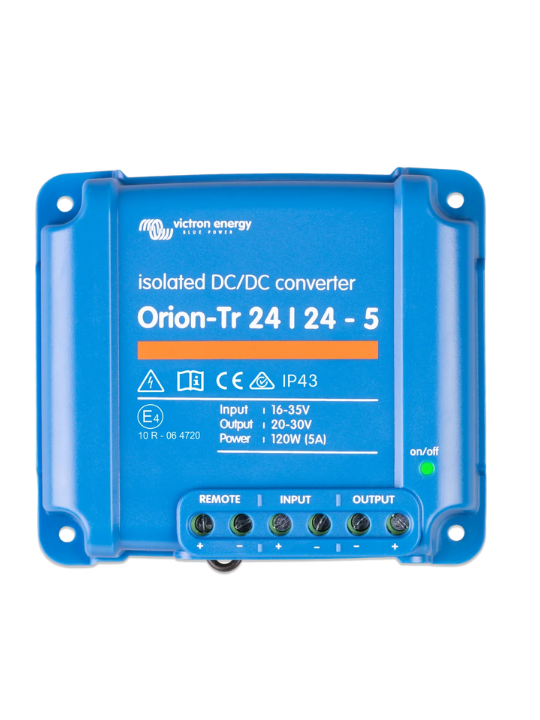
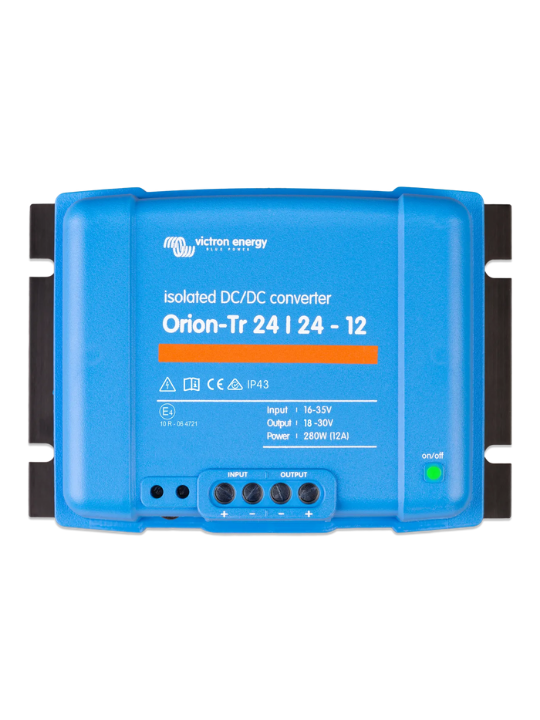
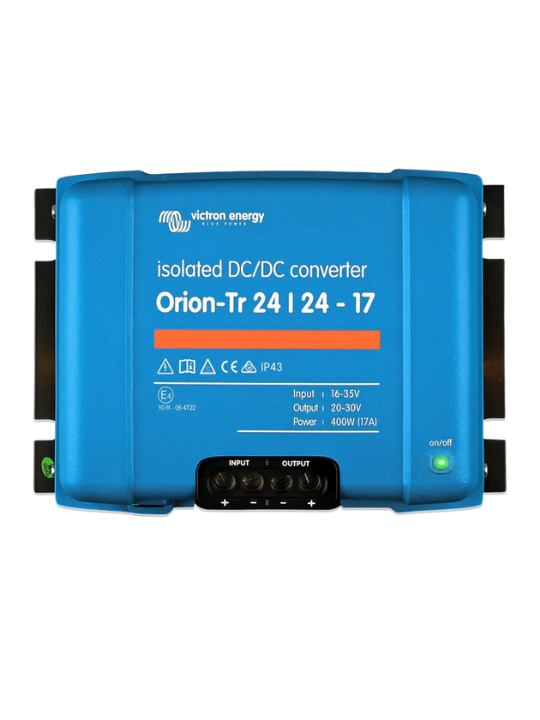
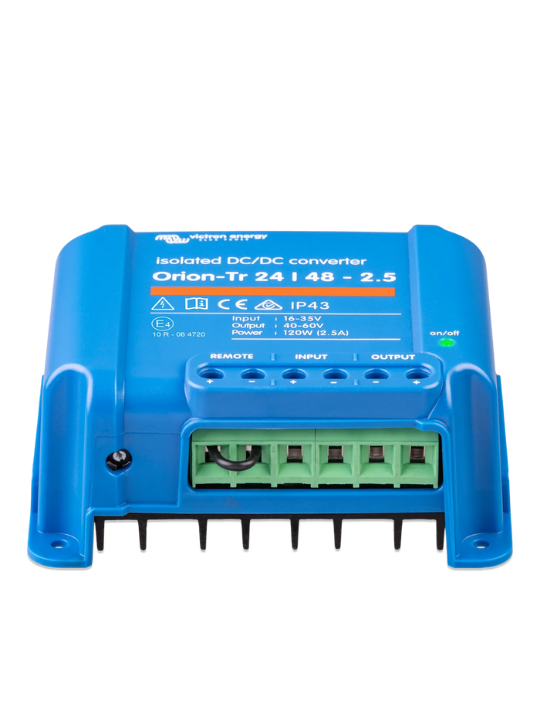
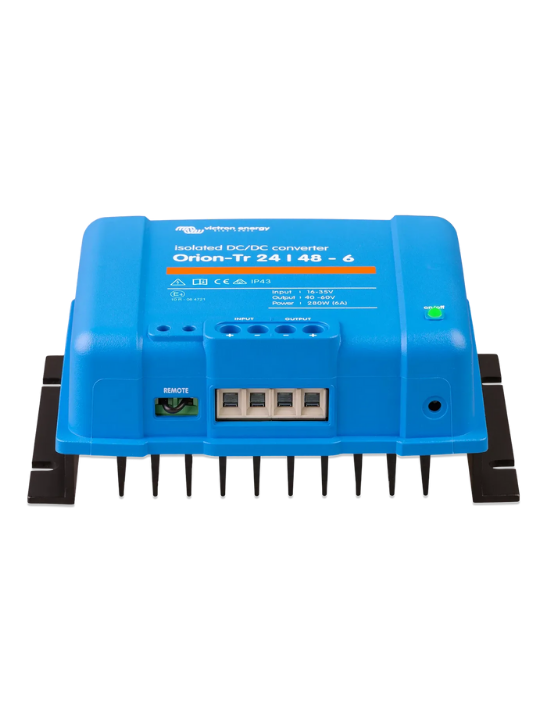
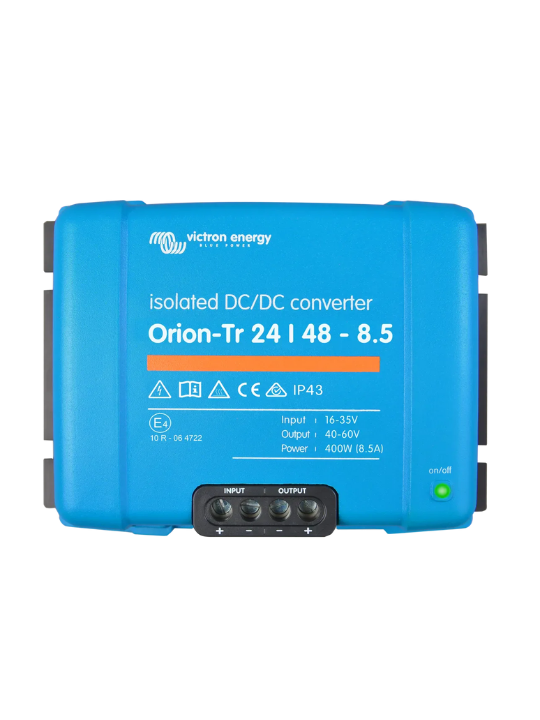
- Galvanic isolation (200 V DC between input, output and case) ensures electrical separation for enhanced safety and reliability.
- Wide input voltage range depending on model e.g., 8-17 V for 12 V systems, 16-35 V for 24 V systems, 32-70 V for 48 V models.
- Adjustable output voltage (e.g., 10-15 V on some 12 V output models) and tight output-voltage tolerance of ±0.2 V.
- High efficiency (typically 87-89 %) to minimise losses and heat generation.
- Parallel operation support unlimited units can be connected in parallel to increase output current.
- Remote on/off input eliminates the need for a heavy‐duty high current switch – a low-power switch or engine run/stop can control it.
- Screw-terminal connections for ease of installation; IP43 protection when installed with terminals downwards.
- Robust protection features: short-circuit proof, over-heat protection by reducing output voltage, reverse polarity protection via fuse and diode.
Powerbox Australia - Operating temperature range -20 °C to +55 °C (with derating above ~40 °C).
The Victron Energy Orion-Tr series of isolated DC-DC converters are high-quality, robust devices designed to convert one DC voltage to another in demanding applications. With a wide range of input and output voltage combinations and power rates, these converters are suited for large 12 V, 24 V or 48 V battery systems. The series supports models such as 24 V to 12 V at 9 A (110 W), 24 V to 48 V at 2.5 A (120 W), 12 V to 24 V at 10 A (240 W), 48 V to 12 V at 30 A (360 W), 24 V to 24 V at 17 A (400 W), 24 V to 48 V at 8.5 A (400 W), among others (see full list below). The units are part of the “isolated” variant so the input and output are galvanically isolated (200 V DC between input, output and case) to reduce noise and provide protection.
Features & Benefits
- Remote On/Off: The Orion-Tr includes a remote on/off terminal, which eliminates the need for a heavy current switch in the input wiring and allows control via a low-power switch or e.g. engine run/stop switch.
- Short-Circuit Proof & Parallelable: All models are short-circuit proof and can be connected in parallel to increase output current. According to Victron, an unlimited number of units can be connected in parallel.
- IP43 Protection: When installed with the screw terminals facing downward, the unit meets IP43 protection rating — splash water and dust protected to a moderate degree.
- Screw Terminals: Installation is straightforward with screw-terminal connections; no special tools required.
- Wide Temperature Range: Operating temperature range –20 °C to +55 °C, derating current above ~40 °C by ~3% per °C.
- Adjustable Output Voltage: Many models allow output voltage adjustment (within a defined range) for fine-tuning. Note: These isolated converters are not intended for battery-charging applications (Victron suggests using the “Smart” variant for battery charging).
- Galvanic Isolation: With 200 V DC isolation between input, output and casing, the unit provides strong isolation for noise suppression and protection of sensitive loads.
Use Cases
- Battery Systems: Ideal for stepping down or stepping up between battery bank voltages in solar / storage systems, e.g., converting from a 48 V battery bank to a 12 V subsystem for lighting or controls.
- Automotive / Marine / Off-Grid: Suitable for large vehicles, boats, RVs, or off-grid installations where one voltage (24 V or 48 V) must power loads at another voltage. The isolation feature helps where grounds may differ or noise must be minimized.
- Industrial / Telecom: In environments where equipment requires stable DC voltages isolated from the main supply noise, these converters can provide regulated output and galvanic isolation.
- Scaling & Custom Systems: Because units can be paralleled, they are useful where higher currents are required; e.g., multiple units in parallel deliver higher output current than a single unit’s rating.
- Higher Reliability Installations: The remote on/off and rugged design make it suitable for systems where remote control or automatic shutdown is required (e.g., when an engine stops, the converter shuts off).
Value Propositions
- Rugged, professional-grade quality: Victron has a strong reputation globally; offering isolated, high-efficiency conversion in harsh environments (heat, humidity, dust) fits well in regions like Tanzania.
- Flexible voltage combinations: Many African installations use mixed systems (24 V, 48 V). Having one converter series covering many combinations means inventory flexibility and less custom sourcing.
- Scalability & reliability: For installation in solar/hybrid systems in Tanzania where expansion may happen and reliability is paramount (e.g., off-grid or rural electrification), the ability to parallel units is a strong advantage.
- Ease of installation: Screw-terminal, remote on/off, no special tools — the installation is simpler for local technicians, reducing labour costs and complexity.
- Isolation and protection: Environments in East Africa may face electrical noise, unstable input sources, or varied grounding; the isolated nature of the Orion-Tr helps protect sensitive equipment.
- Service and warranty backing: Victron offers a strong global support network and warranty, which adds value in markets where service and reliability are key purchasing considerations.
Local Market Positioning in Tanzania
- Target segments: Solar installers, telecom base‐stations, off-grid rural electrification projects, mobile/vehicle energy systems (e.g., converted vans or boats on Lake Victoria), and industrial systems using 24 V/48 V battery banks.
- Pricing consideration: While higher cost than generic converters, the premium pays off in reliability, protection and lifespan — position it as a “system-critical” component rather than a commodity piece.
- Distributor strategy: Emphasize local stock, local support, technical backup, training for installers, and availability of multiple models to serve 12 → 24, 24 → 12, 48 → 12 etc.
- Marketing message: “Reliable conversion — step up or down between 12/24/48 V reliably. Designed for harsh tropical environments. Scalable. Isolated. Built to last.”
- Installation advice: Ensure proper orientation (terminal downwards for IP43 rating), adequate ventilation (especially in high ambient temperatures), use correct cable cross-section, ensure remote on/off wiring supports system shutdown when needed.
- Warranty/promises: Promote the standard 5-year warranty (as per Victron) and global support, which is a differentiator in this market.
Technical Specification
| Model | Input Voltage Range | Nominal Output Voltage | Continuous Output Current | Continuous Output Power | Efficiency | Remarks |
|---|---|---|---|---|---|---|
| 24 V → 12 V 9 A (110 W) | 16-35 V | 12.2 V | 9 A at 25 °C | 110 W | ~85-87% | 110 W” class small size. |
| 24 V → 48 V 2.5 A (120 W) | 16-35 V | 48.2 V | 2.5 A | 120 W | ~88% | Step-up conversion example. |
| 24 V → 12 V 20 A (240 W) | 16-35 V | 12.2 V | 20 A | 240 W | 87% | Higher current 240 W model. |
| 48 V → 12 V 20 A (240 W) | 32-70 V | 12.2 V | 20 A | 240 W | ~87-89% | High input (48 V) version. |
| 48 V → 12 V 30 A (360 W) | 32-70 V | 12.2 V | 30 A | 360 W | ~87% | 360 W” class high current model. |
| 48 V → 24 V 12 A (280 W) | 32-70 V | 24.2 V | 12 A | 280 W | 88% | High input 48 V to 24 V. |
| 12 V → 12 V 30 A (360 W) | 8-17 V | 12.2 V | 30 A | 360 W | ~88% | 12 V in/out high current. |
| 12 V → 24 V 15 A (360 W) | 8-17 V | 24.2 V | 15 A | 360 W | 89% | Step-up 12 V to 24 V. |
| 48 V → 48 V 8 A (380 W) | 32-70 V | 48.2 V | 8 A | 380 W | ~89% | Same voltage in/out (48 V). |
| 24 V → 24 V 17 A (400 W) | 16-35 V | 24.2 V | 17 A | 400 W | ~89% | High power 24 V system. |
| 48 V → 48 V 6 A (280 W) | 32-70 V | 48.2 V | 6 A | 280 W | ~87% | Lower current 48 V in/out model. |
| 48 V → 48 V 2.5 A (120 W) | 32-70 V | 48.2 V | 2.5 A | 120 W | ~89% | Low-power 48 V version. |
| 24 V → 48 V 8.5 A (400 W) | 16-35 V | 48.2 V | 8.5 A | 400 W | ~89% | Step-up 24 V to 48 V high power. |

Save More
Keep more of your money.With our efficient online operation our savings become your savings

Free Same Day Delivery
Spend over 100,000/- with us and qualify for free delivery in Dar Es Salaam. Standard delivery is just 5,000/-*

100% Warranty Goods
Unlike other online retailers we chose our suppliers carefully ensuring genuine goods backed by genuine warranties

7 Day Return
Something faulty with your product? No problem. We will arrange for an easy pick up and refund of your order within 7 days*.
Shop with complete peace of mind.
*Only available for products delivered in Dar es Salaam
Related products

EVI Power 12V 100Ah Deep Cycle Solar Power Battery
Original price was: Tsh 460,000.Tsh 430,000Current price is: Tsh 430,000.

EVI Power 51.2V 100Ah LiFePO4 Rack Mounted Battery Pack with LCD Display – 10.24kWh Capacity, 80% DOD 7000+ Cycles, 5-Year Warranty – EVIA100LFP-51.2
Original price was: Tsh 2,900,000.Tsh 2,760,000Current price is: Tsh 2,760,000.

EVI Power 3.6kW Smart Hybrid Solar Inverter 24V, MPPT Charger, WiFi – EVI-SM3600-24
Original price was: Tsh 2,000,000.Tsh 1,880,000Current price is: Tsh 1,880,000.

EVI Power DC MCCB, 1 Pole, 160A, 1 Year Warranty
Original price was: Tsh 110,000.Tsh 97,000Current price is: Tsh 97,000.

EVI Power 12V 200Ah Deep Cycle Solar Power Battery
Original price was: Tsh 1,000,000.Tsh 950,000Current price is: Tsh 950,000.
EVI Power 51.2V 200Ah LiFePO4 Rack Mounted Battery Pack with LCD Display – 10.24kWh Capacity, 80% DOD 6000+ Cycles, 5-Year Warranty (EVIA200LFP-51.2R)
Original price was: Tsh 8,290,000.Tsh 7,890,000Current price is: Tsh 7,890,000.
JA Solar 595W Bifacial Solar Panel, N-Type TOPCon Technology, Double Glass – JAM72D40-595/LB
Original price was: Tsh 320,000.Tsh 300,000Current price is: Tsh 300,000.